Señales de Alerta MBTI: Una Mirada Honesta a Cada Tipo de Personalidad | MBTI Type Guide
Señales de Alerta de Cada Tipo MBTI: Una Mirada Honesta
Cada tipo de MBTI tiene sus peculiaridades, ¡y algunas de ellas pueden ser, bueno, señales de alerta! Vamos a reírnos un poco de nosotros mismos, ¿qué te parece? Descubre a qué prestar atención en cada personalidad.
Alex Chen26 de março de 20264 min de leitura
Resposta Rápida
Este artículo ofrece un análisis humorístico y 'salvaje' de las 'señales de alerta' específicas asociadas con cada uno de los 16 tipos de personalidad MBTI, detallando sus peculiaridades negativas, desde los sabelotodos condescendientes (INTJ) hasta los buscadores de atención dramáticos (ESFP). Sirve como una guía para reconocer estas fallas en uno mismo y en los demás, promoviendo la autoconciencia y una mejor comprensión de las dinámicas interpersonales.
Principais Conclusões
Cada tipo de MBTI posee 'señales de alerta' o peculiaridades negativas distintas, que van desde la actitud condescendiente del INTJ y la naturaleza arrolladora del ENTJ hasta la pasivo-agresividad del INFJ y el drama en busca de atención del ESFP.
Estas fallas se clasifican por temperamento (Analistas, Diplomáticos, Centinelas, Exploradores), destacando temas comunes como la arrogancia intelectual de los Analistas, las tendencias manipuladoras de los Diplomáticos, la rígida adhesión a las reglas de los Centinelas y la impulsividad o falta de fiabilidad de los Exploradores.
El artículo enfatiza que reconocer estas señales de alerta específicas, tanto en uno mismo como en los demás, es un primer paso crucial hacia la autoconciencia y la mejora de las interacciones interpersonales, presentado con un tono humorístico y 'salvaje'.
Las luchas específicas incluyen problemas de compromiso (INTP, ISFP), evitación de conflictos (ESFJ, ISFP), tendencias de control (ENTJ, ESTJ) y una necesidad de validación constante (ESFJ), ofreciendo una 'guía de supervivencia' para navegar por estos rasgos de personalidad.
Okay, let's be real. We all have our flaws. And sometimes, those flaws are waving bright red flags like they're directing traffic. But hey, self-awareness is the first step to not being that person, right?
So, buckle up, buttercups, because we're about to take an honest (and slightly savage) look at the red flags of each MBTI type. Consider this your survival guide to dating, befriending, or even just tolerating the people in your life – including yourself. Get ready for some real talk, because nobody's perfect, and some imperfections are just… louder than others.
Remember, this is all in good fun! A little self-awareness and a dash of humor can go a long way.
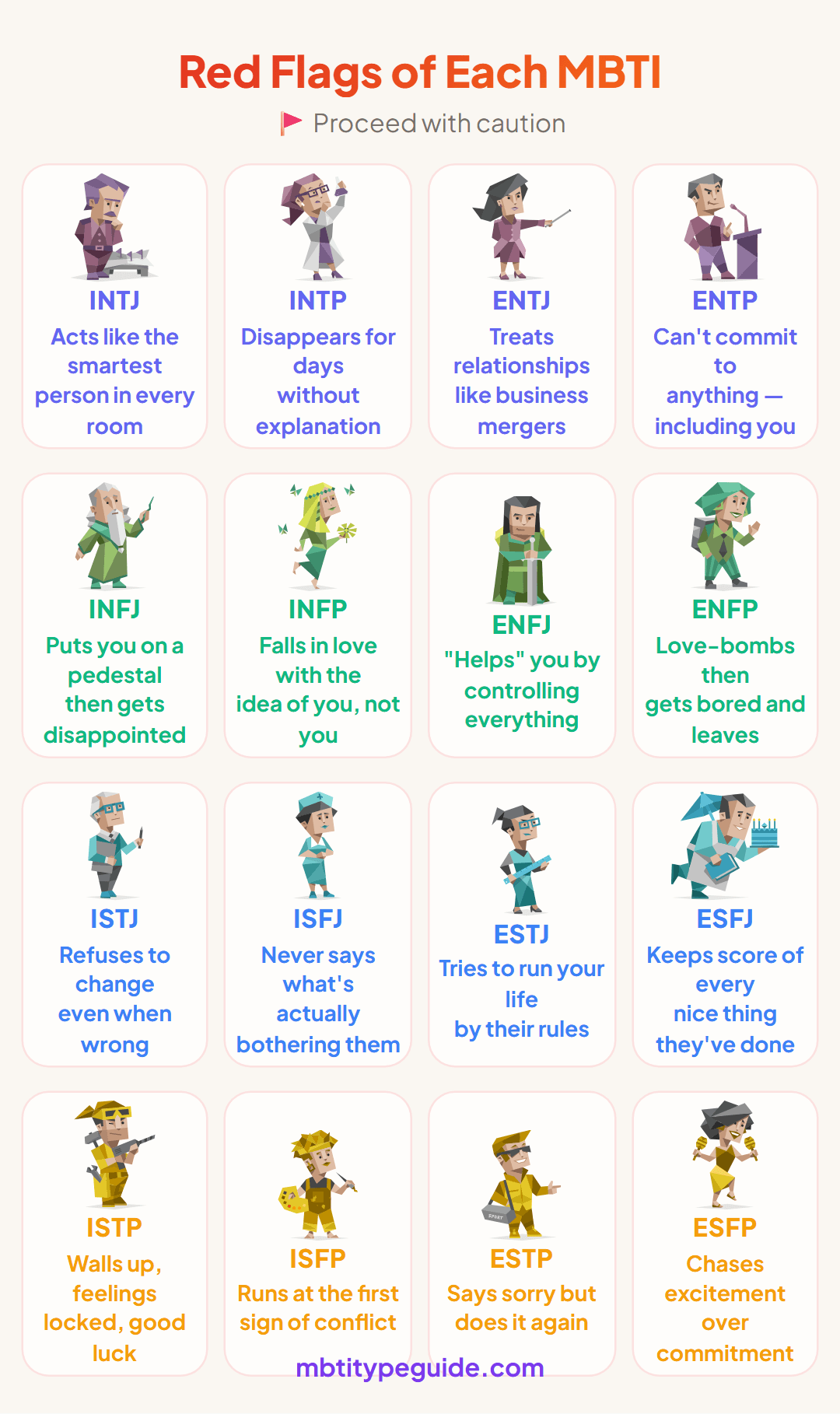
Infographic by mbtitypeguide.com
The Analysts (NT)
INTJ — The Architect
The 'Mastermind' who thinks they're always right? Yeah, that's an INTJ red flag. They can become condescending know-it-alls who dismiss anyone who doesn't meet their intellectual standards. Good luck getting them to admit they’re wrong – you’d have better luck teaching a cat to do algebra.
INTP — The Logician
INTPs are notorious for getting lost in their own heads and becoming detached from reality. They might start a debate over the most insignificant details and then ghost you mid-argument. Plus, good luck getting them to commit to anything – they're allergic to deadlines.
ENTJ — The Commander
ENTJs can be bulldozers, plain and simple. They're so focused on achieving their goals that they'll run over anyone who gets in their way. Expect a power struggle if you disagree with them... and expect to lose. Also, their resting face just screams, 'I'm judging you.'
ENTP — The Debater
Ah, the 'Debater' who loves to argue just for the sake of arguing. ENTPs will gleefully play devil's advocate, even if it means defending the indefensible. They can be incredibly frustrating to deal with because they rarely take anything seriously. Also, they will start 17 different projects and finish none.
The Diplomats (NF)
INFJ — The Advocate
INFJs are the 'Mystics' who seem all sweet and understanding... until you betray their values. Then, watch out for the silent treatment of doom. They also tend to martyr themselves for others and then resent you for it later. Passive-aggressive doesn't even begin to cover it.
INFP — The Mediator
INFPs live in a world of rainbows and unicorns, which is lovely until reality crashes down on them (and everyone around them). They can be overly sensitive and take everything personally. Also, good luck getting them to make a decision – they'll be stuck in analysis paralysis forever.
ENFJ — The Protagonist
ENFJs want to save the world, one person at a time, and they will guilt you into participating. They have a knack for manipulating situations to their advantage while making you feel like it was your idea all along. And if you reject their help? Prepare for the dramatic waterworks.
ENFP — The Campaigner
ENFPs are like puppies – energetic, enthusiastic, and easily distracted. They'll bombard you with a million ideas, then abandon them all halfway through. And don't even think about trying to keep them on schedule. They're basically allergic to routine and will likely start a drum circle out of protest.
The Sentinels (SJ)
ISTJ — The Logistician
ISTJs are the 'Logisticians' who live by the rules, and they expect you to do the same. They can be incredibly rigid and judgmental of anyone who deviates from their black-and-white worldview. Spontaneity? Forget about it. Also, they never forget anything – especially your mistakes.
ISFJ — The Defender
ISFJs are the 'Defenders' who are always taking care of everyone else, which is great until they become resentful and burnt out. They have a hard time saying no, and they'll silently suffer while doing things they hate. And if you don't appreciate their efforts? Expect a guilt trip of epic proportions.
ESTJ — The Executive
ESTJs are the 'Executives' who are always in charge, whether you like it or not. They can be bossy, controlling, and dismissive of anyone who doesn't share their work ethic. They also have zero tolerance for incompetence or inefficiency. Good luck relaxing around them.
ESFJ — The Consul
ESFJs are the 'Consuls' who thrive on social harmony, which means they'll often avoid conflict at all costs. This can lead to them being passive-aggressive and gossipy. They also need constant validation and approval, so prepare to shower them with compliments.
The Explorers (SP)
ISTP — The Virtuoso
ISTPs are the 'Virtuosos' who are cool, calm, and collected... until you try to get them to talk about their feelings. Then, they'll clam up faster than you can say 'vulnerability.' They also have a penchant for dangerous hobbies, so don't be surprised if they show up with a broken arm.
ISFP — The Adventurer
ISFPs are the 'Adventurers' who are all about living in the moment, which means they're not great at planning or commitment. They can be flaky and unreliable, disappearing without a trace when they feel overwhelmed. They also tend to avoid conflict by silently seething.
ESTP — The Entrepreneur
ESTPs are the 'Entrepreneurs' who are always looking for the next thrill, which can lead to them being impulsive and reckless. They'll take any risk, no matter how foolish, just for the adrenaline rush. They also have a tendency to be insensitive and say whatever's on their mind, consequences be damned.
ESFP — The Entertainer
ESFPs are the 'Entertainers' who love being the center of attention, and they'll do anything to stay there. They can be dramatic, attention-seeking, and superficial. They also tend to be easily bored, so don't expect them to stick around for long if you're not entertaining enough.
What's Your Take?
So, there you have it – a not-so-gentle reminder that we're all wonderfully flawed. The good news is, recognizing these red flags is the first step to mitigating them (or at least being aware of when you're about to unleash your inner monster).
Which of these red flags hit a little too close to home? And, more importantly, what are you going to do about it?
Data-driven MBTI analyst with a background in behavioral psychology and data science. Alex approaches personality types through empirical evidence and measurable patterns, helping readers understand the science behind MBTI.
Receba Insights de Personalidade
Artigos semanais sobre carreira, relacionamentos e crescimento — adaptados ao seu tipo de personalidade.