ENFJ and ENTP Compatibility
Explore the relationship dynamics between ENFJ (The Protagonist) and ENTP (The Debater)
ENFJ and ENTP share 2 dimension(s) and differ on 2. This creates a dynamic relationship with both natural understanding and growth opportunities.
Shared dimensions: E/I, S/N
Compatibility by Area
What You Share
- +Both draw energy from social interaction
- +Both are drawn to abstract ideas and future possibilities
How You Complement Each Other
- ↔One offers objective analysis while the other ensures people's feelings are considered
- ↔One provides structured planning while the other brings adaptability
Potential Challenges
- !Decision-making conflicts — one prefers logical analysis while the other considers emotional impact first
- !Planning disagreements — one wants things settled while the other prefers keeping options open
Communication Tips
Practice active listening and validate each other's perspective before offering solutions
The T type should acknowledge feelings before analyzing problems; the F type should present concerns with clarity
Set clear expectations about deadlines and flexibility — find a middle ground between structure and spontaneity
Key Insights
- 1Energy match: both are extraverts who love engagement. The ENFJ's people-energy grounds the ENTP's idea-energy, and vice versa
- 2Structure vs freedom: the ENFJ needs direction, the ENTP needs options. 'Here's where we're going; how we get there is open' satisfies both
- 3Emotional engagement gap: lead with two seconds of 'that sounds hard' before shifting to analysis. Those two seconds matter
- 4Growth-producing: the ENTP challenges the ENFJ's people-pleasing; the ENFJ challenges the ENTP's emotional avoidance
- 5They build lives of purpose and possibility — the ENFJ provides the why, the ENTP provides the what-if
In-Depth Analysis
1The Energy Match
Both ENFJ and ENTP are extraverts who run on engagement. Both light up in conversation, both feed off the energy of others, and both would rather talk through an idea than sit with it quietly. The energy match is immediate — these two can talk for hours, bouncing from topic to topic, and neither person is the one who gets tired first.
But the energy has different flavors.
The ENFJ's energy is directed outward toward people. They're attuned to emotional dynamics, relationship maintenance, and the complex web of who needs what. Their conversations circle back to humans — how they feel, what they need, how to help them grow.
The ENTP's energy is directed outward toward ideas. They're attuned to possibilities, patterns, and the thrill of discovering something nobody else has seen. Their conversations spiral outward into theories — what could be, what might work, what would happen if.
The ENFJ finds the ENTP's idea-energy exciting. Finally, someone who thinks big, who isn't constrained by convention, who makes their mind move in new directions.
The ENTP finds the ENFJ's people-energy grounding. Finally, someone who cares about the human dimension, who brings warmth to the ENTP's sometimes-cold intellectual landscape, who reminds them that ideas exist to serve people.
The combination is dynamic. Sometimes it's also combustible.
2The Structure Versus Freedom Tension
The ENFJ likes plans. Not rigid plans — meaningful plans. They want to know where the relationship is going, what the shared goals are, how both people are contributing to the shared vision. Fe-Ni gives the ENFJ a future-oriented, people-centered planning instinct that makes them natural relationship architects.
The ENTP likes options. Not chaos — options. They want to know that the future is open, that changes are possible, that nobody has locked them into a path they can't modify. Ne-Ti gives the ENTP an exploratory, possibility-centered instinct that makes them natural boundary-resisters.
The ENFJ proposes a plan. The ENTP proposes an alternative. The ENFJ feels dismissed. The ENTP feels controlled.
This isn't a values clash — it's a process clash. Both people want a good future. They just have different relationships with how defined that future should be.
The resolution: flexible frameworks. The ENFJ gets the structure they need — shared goals, general direction, some predictability. The ENTP gets the freedom they need — room to adjust, space to explore, the understanding that the plan is a starting point, not a contract.
'Here's what we're aiming for. How we get there is open.' That sentence satisfies both types. The ENFJ hears the commitment. The ENTP hears the flexibility. Both can breathe.
3The Emotional Engagement Gap
The ENFJ engages emotionally with everything. Their Fe-dominant function means they process the world through feelings — not just their own, but everyone's. When something happens in the relationship, the ENFJ's first response is emotional: how does this feel? What does this mean for us? How are we?
The ENTP engages intellectually with everything. Their Ne-Ti stack means they process the world through ideas and analysis. When something happens in the relationship, the ENTP's first response is conceptual: why did this happen? What are the variables? How can we optimize?
The ENFJ needs emotional engagement to feel connected. When they share something vulnerable, they want the ENTP to meet them in the feeling space — not with solutions, not with analysis, not with a pivot to a related topic. Just: 'I hear you. That matters.'
The ENTP provides intellectual engagement naturally and emotional engagement with effort. They're not cold — they're differently wired. The ENTP cares deeply. They just express caring through ideas rather than feelings.
The ENFJ who understands this stops interpreting the ENTP's intellectual response as emotional avoidance. The ENTP who understands this starts leading with a moment of emotional presence before shifting to analysis.
It's a small adjustment. Two seconds of 'that sounds hard' before 'here's what I think we should do.' Those two seconds matter more than the ENTP realizes.
4The Growth They Spark
ENFJ-ENTP is a growth-producing pairing because each person challenges the other's default mode.
The ENTP challenges the ENFJ's people-pleasing. The ENFJ's instinct to maintain harmony sometimes comes at the cost of honesty. The ENTP, who values truth over comfort, gently — or not so gently — points out when the ENFJ is sacrificing their own needs to keep others happy. 'Why did you agree to that? You don't want to do it.' The ENFJ, hearing this from someone they trust, starts to question patterns they've never questioned before.
The ENFJ challenges the ENTP's emotional avoidance. The ENTP's instinct to intellectualize sometimes comes at the cost of connection. The ENFJ, who values emotional authenticity, persistently — but not aggressively — invites the ENTP into deeper emotional territory. 'I don't want your analysis right now. I want to know how you feel.' The ENTP, receiving this from someone who creates safety, starts accessing emotions they've been avoiding.
Both people push each other toward a more complete version of themselves. The ENFJ becomes more honest. The ENTP becomes more emotionally present. Neither loses their core identity — the ENFJ is still warm, the ENTP is still cerebral — but both expand.
The expansion isn't always comfortable. Growth rarely is. But the ENFJ-ENTP couple that embraces discomfort as a feature rather than a flaw builds a relationship that deepens over time instead of stagnating.
5The Life of Possibility and Purpose
ENFJ-ENTP couples build lives that are simultaneously purposeful and spontaneous. The ENFJ provides the purpose — the vision, the values, the 'why.' The ENTP provides the possibility — the innovation, the alternatives, the 'what if.'
Their social life is rich because both are extraverts who enjoy people. Their intellectual life is rich because the ENTP ensures there's always a new idea on the table. Their emotional life is rich — eventually — because the ENFJ insists on depth even when the ENTP would rather stay on the surface.
The couple that thrives has learned to value each other's contributions even when they don't share them. The ENFJ values the ENTP's intellectual restlessness even when they'd prefer more focus. The ENTP values the ENFJ's emotional investment even when they'd prefer more lightness.
An ENFJ described their ENTP: 'He makes me laugh at the things I used to take too seriously. Not in a dismissive way — in a liberating way. He showed me that not everything requires emotional processing. Some things can just be funny. Some things can just be interesting. I was so busy feeling everything that I forgot how to simply enjoy things. He gave that back to me.'
The ENTP: 'She gave my ideas a heart. I used to think the idea was enough — if it was clever, if it was original, if it was logically sound, that should be sufficient. She showed me that an idea without empathy is just noise. The best ideas I've ever had are the ones she touched — because she added the human dimension I was missing. Not by dumbing them down. By deepening them.'
That's ENFJ-ENTP at its best: purpose and possibility, heart and mind, warmth and wit. Neither alone is complete. Together, they're the whole picture.
Type Profiles
The Protagonist
“The Teacher”
ENFJs are charismatic and inspiring leaders who are able to mesmerize their listeners. They are warm, empathetic, and responsive people who are highly attuned to the emotions and needs of others. ENFJs have a natural talent for motivating and guiding people.
View full profileThe Debater
“The Visionary”
ENTPs are smart, curious thinkers who cannot resist an intellectual challenge. They are quick-witted, resourceful, and love exploring new ideas and possibilities. ENTPs enjoy debating concepts and finding creative solutions to complex problems.
View full profileExplore More Pairs
Related Articles
The ENFJ-INFP 'Golden Pair': Beyond Initial Spark to Lasting Connection
Often hailed as the 'Golden Pair,' the ENFJ-INFP relationship promises profound connection. Yet, its true longevity lies not in idealism, but in the deliberate management of their distinct emotional worlds and social needs.
Why Your MBTI Compatibility Chart Lies About Lasting Love
The simplistic pairings promised by MBTI compatibility charts offer little real insight into lasting relationships. Scientific evidence points to more robust models for understanding true connection.
Your Unseen Weakness: How the Inferior Function Shapes Your Closest Bonds
Often dismissed as mere 'weakness,' your least preferred cognitive function silently orchestrates profound challenges in your intimate relationships. This is not about avoiding conflict. It is about uncovering the hidden architecture of your emotional world.
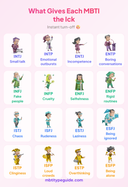
What Instantly Gives Every MBTI Type the Ick
Ever wondered what makes each MBTI type cringe? From fake enthusiasm to illogical arguments, we've got the ultimate list of instant turn-offs!
Discover Your Type
Take our free personality test and find your compatibility with all 16 types.