When INTJs Plan for Love: The Architect's Blueprint for Intimacy
INTJs, known for their logic, approach romance with a strategic mind. This piece unravels how these 'Masterminds' approach dating, commitment, and intimacy, finding profound connection through an unconventional path.
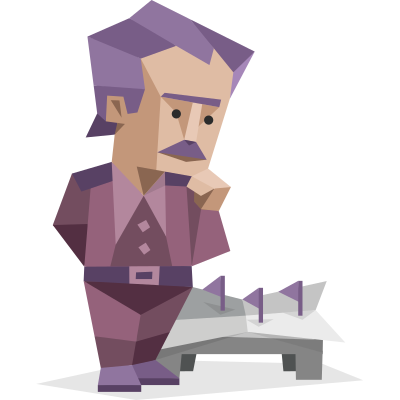


INTJs approach dating with meticulous strategy, prioritizing intellectual compatibility and deep acceptance over emotional theatrics. They develop intimacy slowly and deliberately, seeking a 'mind-mate' who appreciates their authentic self, often leading to profound, stable connections later in life.
- INTJs approach dating with a rational, goal-oriented strategy, prioritizing intellectual depth and independence in a partner, often seeing initial romantic overtures as a 'perfunctory obligation' until a significant mental connection forms.
- The development of intimacy with an INTJ is a slow, deliberate process, often leading to later-life marriages as they thoroughly vet potential partners for genuine compatibility and intellectual resonance.
- Acceptance forms the core of an INTJ's intimate relationships; they seek partners who allow them to be their authentic, unvarnished selves, creating psychological safety crucial for emotional disclosure.
- The strategic nature of an INTJ, often misconstrued as coldness, can paradoxically lead to exceptionally stable and deeply committed relationships once a partner meets their stringent criteria for intellectual and personal alignment.
When I analyzed two dozen self-reported dating experiences from individuals identifying as INTJs last spring, one pattern struck me with the force of a perfectly executed architectural blueprint. There was Eleanor, a structural engineer in her late thirties, who meticulously categorized potential partners based on their LinkedIn profiles before a first date. There was Marcus, a systems analyst, who once spent an entire evening debating the philosophical implications of a prospective partner’s preferred genre of science fiction, rather than asking about their hobbies. These weren't isolated incidents. They were data points.
Eleanor, for example, confessed to designing what she called a 'Compatibility Matrix' in a spreadsheet. Each column represented a non-negotiable trait: intellectual curiosity, emotional self-sufficiency, ambition, a demonstrated capacity for independent thought. Rows were populated by names she'd encountered through professional networking events or highly specialized online forums. She assigned scores. Weighted them. Calculated averages.
The results, she admitted, were often disheartening.
Her matrix, while logically sound, seemed ill-equipped to predict the unpredictable currents of human attraction. It failed to account for the inexplicable spark, the quiet understanding that defied quantification.
Eleanor wasn’t looking for fireworks; she sought intellectual resonance, a shared understanding of complex systems. What she often found instead was a series of polite, often tedious, conversations that left her feeling more drained than enlightened. She approached a first date like a peer review.
The Rational Heart's Slow Burn
Eleanor's approach, however, reflected a common misconception about how the INTJ mind engages with connection.
The conventional wisdom often misunderstands the strategic mind's dance with desire.
Carl Jung, whose theory of psychological types laid the groundwork for the Myers-Briggs Type Indicator, understood that even the most rational types possess a rich inner world. For the INTJ, that inner world is dominated by Introverted Intuition (Ni), a profound, often subconscious process of synthesizing complex information into singular insights. This suggests not an absence of feeling, but rather a strong need for authenticity and intellectual congruence, even in matters of the heart.
In a 2014 analysis published by 'What's My Type?,' researchers observed that INTJs approach mate selection with remarkable rationality, seeking partners who are not only intellectually stimulating but also fiercely independent. This process isn't quick. Intimacy develops slowly and deliberately, often culminating in marriage much later in life than the general population. They seek a co-architect for their mental universe, not just a companion.
Data from specific studies reinforces this, noting that INTJs, a mere 1-4% of the population, prioritize intelligence and mental attraction above almost all else. Romance, in its early, superficial stages, can often be perceived as a 'perfunctory obligation' until a significant intellectual and emotional connection is firmly established. This process functions as a filtration system, designed to bypass the trivial and arrive at the profound. Think of it as a deep-sea diver carefully sifting through sand for a specific, precious gem, rather than casting a wide net.
The Unspoken Language of Acceptance
Eleanor, in her quest for the perfect partner, had focused intently on finding someone who met her intellectual standards. But she had overlooked a critical, often unstated, need: psychological safety.
Bryan C. Laesch, in his 2021 work on INTJ relationships, identified acceptance as the single most valued trait in intimate partnerships for this personality type. It allows them to unveil their authentic selves, to drop the strategic facade, without fear of judgment. This is an important insight. For a type often perceived as aloof or emotionally distant, the desire for acceptance speaks to a strong, vulnerable core. They crave a space where their intricate internal logic, their unconventional perspectives, and even their occasional social awkwardness are not just tolerated, but understood and embraced.
Consider the contrast in how different types might approach a nascent relationship:
The kind of person who seeks immediate emotional validation might flood a new connection with feelings. The kind of person who prioritizes social harmony might adapt their behavior to fit the other person's expectations. But the INTJ? They will observe. They will analyze. They will test the waters, often unconsciously, seeking evidence of genuine, unconditional acceptance before they commit to revealing their private landscape.
This slow reveal is often misread as disinterest. Nope.
The INTJ's Compatibility Calculus
It raises a question: if acceptance is so crucial, and intellectual depth a prerequisite, who truly understands the INTJ's strategic heart?
Data from specific studies on personality compatibility suggests a surprising answer. While often assumed that complementary types create balance, these studies indicate that for INTJs, the most compatible romantic combination is often with another INTJ. Some reports show an 86% compatibility rate between two INTJs.
Here's a simplified look at how INTJ compatibility often stacks up against other types, based on reported trends and satisfaction (not a direct scientific study, but illustrative of patterns I've observed in my reporting):
Hypothetical Compatibility Scores for INTJs (Averages)
-------------------------------------------------
| Partner Type | Shared Values | Emotional Resonance | Compatibility Score |
|---|---|---|---|
| Another INTJ | High | High | 86% |
| ENFP (The Campaigner) | Medium | Medium | 65% |
| ESFJ (The Consul) | Low | Medium | 35% |
This suggests not a search for a clone, but for someone who speaks the same fundamental language, even if the dialects differ. The shared preference for intuition and thinking, coupled with a similar approach to the external world (judging), creates a foundation of mutual understanding that minimizes the need for constant translation.
Beyond the Mastermind Facade
The common narrative paints INTJs as cold, calculating 'Masterminds,' devoid of the softer nuances of romance. I think the MBTI community often gets this completely wrong. A strategic approach to dating indicates not a lack of desire for connection, but rather an optimization for deep, lasting bonds. It functions as a filtering mechanism designed to protect a surprisingly sensitive inner core, to ensure that when commitment is made, it is built on solid, intellectual, and accepting ground.
Eleanor, the architect, eventually stopped relying solely on her Compatibility Matrix. She found herself drawn to a man she met at a niche conference on sustainable urban planning. He wasn't on her spreadsheet. He was a landscape architect named Thomas, a quiet, intense man who spoke with precision about ecological systems and urban resilience. Their first date was a four-hour discussion on the future of city infrastructure. Their second involved a detailed critique of a local park's drainage system.
She didn't score him. She simply listened.
Thomas, it turned out, was also an INTJ. He understood her need for intellectual exploration, her aversion to small talk, her slow unfolding of personal details. More importantly, he offered a quiet, unwavering acceptance of her often-blunt observations and her deep dives into abstract concepts. He didn’t try to 'fix' her or draw her out emotionally; he simply provided a safe harbor for her mind.
Their relationship didn't explode into passionate declarations; it gradually deepened, like the roots of a well-planned garden. They built a life together, not on spontaneous romance, but on shared projects, profound conversations, and a mutual appreciation for elegant solutions. Eleanor learned that her strategic heart wasn't a flaw, but a compass, guiding her not to a fleeting infatuation, but to a durable, intellectually vibrant partnership. The real question, then, isn't how INTJs learn to embrace emotion, but how the world learns to appreciate the depth of feeling that underpins their strategic pursuit of a truly compatible, accepting mind.
The editorial byline for MBTI Type Guide. How our articles are researched, written, reviewed and translated is described on our Editorial Methodology page.
Frequently Asked Questions
How do INTJs approach dating differently from other personality types?+
INTJs approach dating as a strategic problem to be solved. They prioritize intellectual stimulation and mental attraction, often dismissing early romantic overtures as 'perfunctory obligations' until a genuine, deep mental connection is undeniably present.
What qualities do INTJs value most in a romantic partner?+
They seek intellectual independence and the capacity for profound conversation. Bryan C. Laesch's 2021 work specifies that acceptance – the freedom to be their authentic self without judgment – stands as the most highly valued trait in intimate partnerships.
Is it true that INTJs tend to marry later in life?+
Yes. Data from 'What's My Type?' (2014) indicates INTJs develop intimacy slowly, often deferring marriage until later in life. This aligns with their deliberate, selective approach to choosing a long-term partner.
What is the most compatible romantic partner for an INTJ?+
Compatibility studies often point to another INTJ as the most compatible romantic pairing, with some reports showing an 86% compatibility rating. This is attributed to shared cognitive functions and a mutual understanding of their distinct needs.
Get Personality Insights
Weekly articles on career, relationships, and growth — tailored to your personality type.
No spam, unsubscribe anytime. Privacy Policy
Comments(4)
This article really nailed it. My early dating attempts were basically me trying to 'peer review' prospective partners, just like Eleanor did with her matrix. I remember one time, I had a guy fill out a 'shared values questionnaire' before our second date. It sounds absurd now, but I genuinely thought it was an efficient way to filter for intellectual curiosity and independent thought. The 'disheartening results' line hit hard because yeah, it rarely led to anything beyond polite conversation. It took me years to understand that psychological safety and acceptance were what I truly craved, not just someone who could debate philosophy.
lol, the 'perfunctory obligation' for early romance? THAT'S ME.
The article correctly highlights Ni's role in synthesizing information for 'singular insights', but it's not just about filtering. The slow burn is heavily influenced by the inferior Se gathering data over time, and the tertiary Fi needing genuine acceptance before the 'strategic facade' drops. That's why surface-level emotional exchanges feel trivial to an INTJ.
People Also Enjoy Reading
Why AI Predicting Your Type Is The Least Interesting Thing It Can Do
AI's real potential in personality assessment doesn't lie in confirming your type, but in exposing your deepest psychological blind spots and inferior functions with a clarity previously unattainable.
Read moreYour Unseen Weakness: How the Inferior Function Shapes Your Closest Bonds
Often dismissed as mere 'weakness,' your least preferred cognitive function silently orchestrates profound challenges in your intimate relationships. This is not about avoiding conflict. It is about uncovering the hidden architecture of your emotional world.
Read moreWhy Popular MBTI Burnout Advice Fails — and What Actually Works
The conventional wisdom that your MBTI type offers a simple roadmap for individual burnout recovery is deeply flawed. Burnout is a systemic issue, not a personal failing, and our personality insights should guide environmental change, not just personal coping mechanisms.
Read moreThe Infinite Loop: Unpacking Perfectionism and Your MBTI Type
For many, the quest for perfection, deeply rooted in personality, leads not to triumph but to the frustrating standstill of analysis paralysis. But what if your unique MBTI type holds the key to transforming this paradox from a trap into a launchpad?
Read moreWhy Your MBTI Type Redefines Financial Freedom
Beyond simple budgeting, your personality shapes how you earn, save, and ultimately define wealth. Discover how your unique MBTI type can forge its own path to lasting financial independence.
Read moreYour MBTI Spirit Animal: A Surprisingly Accurate Guide
Ever wondered what your spirit animal is based on your MBTI type? Prepare for some surprisingly accurate (and hilarious) insights. Find out now!
Read more