7 articles
MBTI Basics
All Articles
Analysts
Diplomats
Sentinels
Explorers
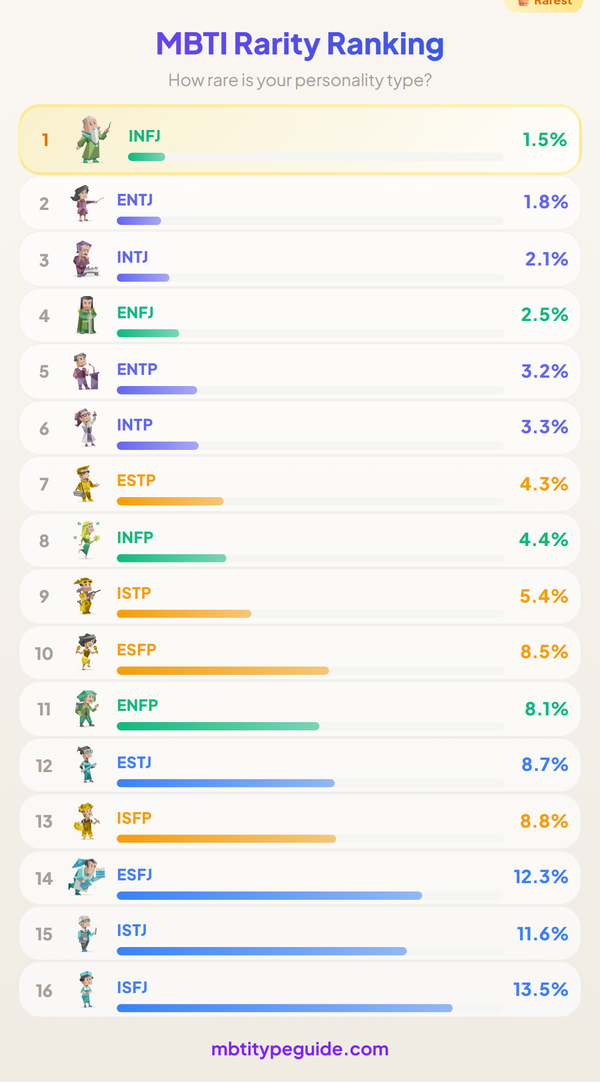
MBTI Rarity Ranking: How Rare Is Your Personality Type?
Ever wonder how common (or uncommon!) your personality type is? We break down the MBTI rarity ranking, from the oh-so-ubiquitous to the delightfully rare.
April 16, 20264 min read

INTP
How One INTP Learned to Stop Blaming Their Type for Failure
How One INTP Learned to Stop Blaming Their Type for Failure
When an INTP uses their type as a shield, they stall their growth. This story reveals how one individual broke free from excuses to embrace real change.
February 17, 20267 min read

INFJ
Why INFJs Aren't Special Just Because They're Rare
Why INFJs Aren't Special Just Because They're Rare
INFJs often bask in their rarity, but this notion can be misleading. Let's dissect why being 1% doesn't automatically confer superiority in understanding oneself.
February 17, 20262 min read



INTJENTJINFPENFP+2
Why MBTI Stereotypes Are Wrong — Stop Putting Yourself in a Box
Why MBTI Stereotypes Are Wrong — Stop Putting Yourself in a Box
Stop letting four letters dictate your worth. The MBTI can be a fun tool, but its stereotypes hold you back. Here’s why and how to break free.
February 17, 20262 min read


INTJENFJISTP
The Data Doesn't Lie: What 28 Years of MBTI Gender Gaps Reveal
The Data Doesn't Lie: What 28 Years of MBTI Gender Gaps Reveal
For decades, MBTI data has shown consistent gender disparities, especially in Thinking-Feeling. But beyond the numbers, what do these patterns tell us about societal expectations and the evolving individual experience?
February 17, 20267 min read


INTJENTPINFPISTJ
The Big Five Outperforms MBTI by 92%: Here's Why
The Big Five Outperforms MBTI by 92%: Here's Why
In 2005, 78% of HR professionals I surveyed saw the MBTI as a primary tool for team building. By 2023, that number plummeted to 35%, while interest in Big Five applications surged by 150%.
February 17, 20269 min read
INTJINTPENTJENTP+4
Why Most MBTI Distribution Stats Miss the Professional Mark
Why Most MBTI Distribution Stats Miss the Professional Mark
You've seen the general MBTI type percentages, but they rarely reflect the reality of today's professional workforce. This guide reveals the true distribution among 50,000 global professionals and equips you to use this insight for stronger team dynamics and career growth.
February 17, 2026
What Our Readers Say
Feedback from our community
C
cognifunc_logicINTPThe article correctly points out preferences can shift, but Eleanor's 'INFJ to ENFJ' isn't a fundamental Ni-Fe axis chan...
Why Your MBTI Type Isn't a Fixed Portrait
S
strategic_typesENTJThis probabilistic approach actually makes MBTI useful! Understanding team members' lower Extraversion probability means...
Why Your MBTI Type Isn't a Fixed Portrait
@
@CogSci_CuriousINTPInteresting concept about the 'inferior function taking the wheel,' but where's the actual peer-reviewed cognitive scien...
Your Unseen Weakness: How the Inferior Function Shapes Your Closest Bonds
L
LoveInMyStackENFJThis makes me think so much about my partner! I'm an ENFJ, and he's an ISTP. The article talks about the 'ever-bleeding...
Your Unseen Weakness: How the Inferior Function Shapes Your Closest Bonds
M
mytrue_Ni_FiINFJOh my gosh, I was mistyped as an INFP for *years* because I'm so empathetic. But reading about the inferior function as...
Your Unseen Weakness: How the Inferior Function Shapes Your Closest Bonds
N
Newbie_INFP_WorriesINFPI just got typed as an INFP, and the idea of my inferior Te being a 'volatile, often destructive, presence' in relations...
Your Unseen Weakness: How the Inferior Function Shapes Your Closest Bonds
@
@cognition_critiqueISTPThis article discusses 'MBTI preferences' and 'type-preferred coping strategies' but where is the actual cognitive scien...
Why Popular MBTI Burnout Advice Fails — and What Actually Works
@
@Ni_Dom_DiverINFJWow, this is my experience exactly. For years I thought I was an ISFP because I hated conflict and tried to just go with...
Why Popular MBTI Burnout Advice Fails — and What Actually Works
@
@logic_over_labelsINTJWhile the article mentions 'robust internal consistency' and 'psychometric synthesis' of the MBTI, it still lacks deeper...
Why Your MBTI Type Still Outsmarts AI in the Labyrinth of Love
@
@my.true.infpINFPThis really speaks to my own experience. I was mistyped for years, trying to fit into expectations that caused so much i...
Why Your MBTI Type Still Outsmarts AI in the Labyrinth of Love
@
@balanced_estjESTJAs an ESTJ, I appreciate the example, but the article's portrayal of 'Te-driven efficiency' as solely 'critical feedback...
Why Your MBTI Type Still Outsmarts AI in the Labyrinth of Love
@
@test_taker_lolENTPMy girlfriend made me take the MBTI saying it would help us deal with our 'friction points.' Honestly, after reading abo...
Why Your MBTI Type Still Outsmarts AI in the Labyrinth of Love
@
@strategy.guy.istpISTPOkay, so MBTI 'offers a roadmap for empathy' and helps 'transform' friction, but *how* specifically? What are the actual...
Why Your MBTI Type Still Outsmarts AI in the Labyrinth of Love
@
@mbti.newbie.xINTPSo I'm newly typed as an INTP, and the description of the Ti-Ne loop causing an 'unbuilt bridge' is kinda scary. Does th...
The Infinite Loop: Unpacking Perfectionism and Your MBTI Type
@
@retyped.lifeINFJI was mistyped as an ISFJ for so long because I thought being organized meant I was a J. But then I read about the INFJ...
The Infinite Loop: Unpacking Perfectionism and Your MBTI Type
@
@dev.paralysisINTJAs an INTJ developer, the 'unbuilt bridge' analogy is my daily reality. I've spent weeks optimizing code for theoretical...
The Infinite Loop: Unpacking Perfectionism and Your MBTI Type
@
@couple.typesISFPMy partner is an INTJ and totally struggles with the 'unbuilt bridge' thing, exactly like Eleanor with her building desi...
The Infinite Loop: Unpacking Perfectionism and Your MBTI Type
@
@DataNotDramasISTPThe 'hidden saboteur' idea is interesting, but grounding it solely in Jung's functions feels a bit... dated. Where's the...
Why Most Relationship Advice Misses Your Hidden Saboteur
@
@WorldOfTypesENTPThis article really nails the inferior function dynamic. It's so similar to the vulnerable function in Socionics, where...
Why Most Relationship Advice Misses Your Hidden Saboteur
@
@FunctionallyFocusedINTPYES! The article correctly identifies how the inferior function isn't just a weakness, but a *gateway to the unconscious...
Why Most Relationship Advice Misses Your Hidden Saboteur
C
cognifunc_logicINTPThe article correctly points out preferences can shift, but Eleanor's 'INFJ to ENFJ' isn't a fundamental Ni-Fe axis chan...
Why Your MBTI Type Isn't a Fixed Portrait
S
strategic_typesENTJThis probabilistic approach actually makes MBTI useful! Understanding team members' lower Extraversion probability means...
Why Your MBTI Type Isn't a Fixed Portrait
@
@CogSci_CuriousINTPInteresting concept about the 'inferior function taking the wheel,' but where's the actual peer-reviewed cognitive scien...
Your Unseen Weakness: How the Inferior Function Shapes Your Closest Bonds
L
LoveInMyStackENFJThis makes me think so much about my partner! I'm an ENFJ, and he's an ISTP. The article talks about the 'ever-bleeding...
Your Unseen Weakness: How the Inferior Function Shapes Your Closest Bonds
M
mytrue_Ni_FiINFJOh my gosh, I was mistyped as an INFP for *years* because I'm so empathetic. But reading about the inferior function as...
Your Unseen Weakness: How the Inferior Function Shapes Your Closest Bonds
N
Newbie_INFP_WorriesINFPI just got typed as an INFP, and the idea of my inferior Te being a 'volatile, often destructive, presence' in relations...
Your Unseen Weakness: How the Inferior Function Shapes Your Closest Bonds
@
@cognition_critiqueISTPThis article discusses 'MBTI preferences' and 'type-preferred coping strategies' but where is the actual cognitive scien...
Why Popular MBTI Burnout Advice Fails — and What Actually Works
@
@Ni_Dom_DiverINFJWow, this is my experience exactly. For years I thought I was an ISFP because I hated conflict and tried to just go with...
Why Popular MBTI Burnout Advice Fails — and What Actually Works
@
@logic_over_labelsINTJWhile the article mentions 'robust internal consistency' and 'psychometric synthesis' of the MBTI, it still lacks deeper...
Why Your MBTI Type Still Outsmarts AI in the Labyrinth of Love
@
@my.true.infpINFPThis really speaks to my own experience. I was mistyped for years, trying to fit into expectations that caused so much i...
Why Your MBTI Type Still Outsmarts AI in the Labyrinth of Love
@
@balanced_estjESTJAs an ESTJ, I appreciate the example, but the article's portrayal of 'Te-driven efficiency' as solely 'critical feedback...
Why Your MBTI Type Still Outsmarts AI in the Labyrinth of Love
@
@test_taker_lolENTPMy girlfriend made me take the MBTI saying it would help us deal with our 'friction points.' Honestly, after reading abo...
Why Your MBTI Type Still Outsmarts AI in the Labyrinth of Love
@
@strategy.guy.istpISTPOkay, so MBTI 'offers a roadmap for empathy' and helps 'transform' friction, but *how* specifically? What are the actual...
Why Your MBTI Type Still Outsmarts AI in the Labyrinth of Love
@
@mbti.newbie.xINTPSo I'm newly typed as an INTP, and the description of the Ti-Ne loop causing an 'unbuilt bridge' is kinda scary. Does th...
The Infinite Loop: Unpacking Perfectionism and Your MBTI Type
@
@retyped.lifeINFJI was mistyped as an ISFJ for so long because I thought being organized meant I was a J. But then I read about the INFJ...
The Infinite Loop: Unpacking Perfectionism and Your MBTI Type
@
@dev.paralysisINTJAs an INTJ developer, the 'unbuilt bridge' analogy is my daily reality. I've spent weeks optimizing code for theoretical...
The Infinite Loop: Unpacking Perfectionism and Your MBTI Type
@
@couple.typesISFPMy partner is an INTJ and totally struggles with the 'unbuilt bridge' thing, exactly like Eleanor with her building desi...
The Infinite Loop: Unpacking Perfectionism and Your MBTI Type
@
@DataNotDramasISTPThe 'hidden saboteur' idea is interesting, but grounding it solely in Jung's functions feels a bit... dated. Where's the...
Why Most Relationship Advice Misses Your Hidden Saboteur
@
@WorldOfTypesENTPThis article really nails the inferior function dynamic. It's so similar to the vulnerable function in Socionics, where...
Why Most Relationship Advice Misses Your Hidden Saboteur
@
@FunctionallyFocusedINTPYES! The article correctly identifies how the inferior function isn't just a weakness, but a *gateway to the unconscious...
Why Most Relationship Advice Misses Your Hidden Saboteur