ENFJ and ENFJ Compatibility
Explore the relationship dynamics between ENFJ (The Protagonist) and ENFJ (The Protagonist)
ENFJ and ENFJ share 4 dimension(s) and differ on 0. This creates a dynamic relationship with both natural understanding and growth opportunities.
Shared dimensions: E/I, S/N, T/F, J/P
Compatibility by Area
What You Share
- +Both draw energy from social interaction
- +Both are drawn to abstract ideas and future possibilities
- +Both prioritize values and emotional harmony
- +Both prefer structure and planned approaches
Communication Tips
Practice active listening and validate each other's perspective before offering solutions
Key Insights
- 1Both are givers — but neither is receiving. Two people exhausted from giving and starving from not being still enough to take in love
- 2Name your needs directly: 'I need this' once a week. For two ENFJs, this feels selfish. It's actually survival
- 3Image management: both curate how the relationship looks. Give each other permission to be imperfect — the real relationship is messier and better
- 4The mirror effect: seeing your own patterns in your partner is uncomfortable but transformative. Heal the shared patterns together
- 5The ultimate lesson: receiving is harder than giving for both. Learning to sit still and be cared for is the growth edge
In-Depth Analysis
1The Most Generous Relationship Imaginable
Two ENFJs in a relationship sounds ideal on paper. Both people are warm, attentive, and deeply committed to making their partner feel valued. Both are natural givers. Both prioritize the relationship. Both show up, fully, every single day.
And for a while, it is ideal. The love is abundant, the attention is consistent, and both people feel cherished in a way they've rarely experienced. Every birthday is remembered. Every hard day is met with comfort. Every success is celebrated with genuine pride.
But there's a paradox buried in all this giving: when both people are focused on what the other person needs, who's paying attention to what they need themselves?
The ENFJ's Fe-dominant function means they orient outward — reading the emotional climate, adjusting to others, providing what's needed before it's even requested. In most relationships, this creates a natural caretaker dynamic that works because the other person receives the care.
In an ENFJ-ENFJ relationship, both people are caretaking simultaneously. Both people are reading. Both people are adjusting. Both people are giving — and neither person is receiving, because receiving requires a kind of stillness that the ENFJ finds almost impossible.
The result is two people who are exhausted from giving and starving from not receiving, both too focused on the other to notice their own depletion.
2The Needs They Won't Name
Every ENFJ has needs. Real, specific, sometimes inconvenient needs. But naming those needs — out loud, directly, to another person — feels selfish. And 'selfish' is the word that paralyzes the ENFJ more than any other.
In most relationships, the ENFJ's partner eventually notices the unspoken needs and addresses them, or at least creates space for the ENFJ to voice them. The partner's differentness is what makes the gap visible.
In an ENFJ-ENFJ relationship, neither person is different enough to create that gap. Both people are suppressing their needs with identical skill. Both people are smiling while depleted. Both people are saying 'I'm fine' with the same convincing warmth.
The crisis arrives not as a fight but as a quiet collapse. One ENFJ suddenly can't get out of bed. Or breaks down crying in the car for no apparent reason. Or starts resenting the partner for never noticing what they needed — even though they never said what they needed.
The practice that prevents this is almost embarrassingly simple: take turns asking for something. Not hinting. Not creating situations where the other person should be able to figure it out. Actually saying: 'I need this.' One specific thing. Once a week.
For two ENFJs, this feels like an act of aggression. It's not. It's the minimum viable selfishness required to keep two generous people from giving themselves empty.
3The Image Management Problem
ENFJs care how things look. Not in a vain way — in a values-driven way. They want their life to reflect their ideals. They want their relationship to embody the kind of love they believe in. They want to be the couple that other people admire.
This is mostly harmless and often motivating. But two ENFJs managing the image of their relationship simultaneously can create a dynamic where the performance of the relationship takes priority over the reality of it.
They post beautiful photos. They host wonderful gatherings. They speak about each other in glowing terms. From the outside, it looks perfect.
From the inside, both people feel the gap between what they're showing and what they're living. The Instagram version is real — but it's curated. The difficult conversation that happened before the dinner party doesn't appear. The tension that sat between them all morning is invisible by evening.
Two ENFJs need to give each other permission to be imperfect — not just as individuals but as a couple. The relationship doesn't have to be a showcase. Some of their best moments will be ugly: the argument that finally cleared the air, the breakdown that led to honesty, the evening when both people admitted they were performing and agreed to stop.
The real relationship is messier than the presented one. And for two people who instinctively curate, learning to love the mess is a radical act.
4The Mirror Effect
Two ENFJs together experience something peculiar: they see themselves reflected with uncomfortable clarity.
The ENFJ's tendency to manage others' emotions? Their partner does the same thing — and suddenly it's visible. The ENFJ's habit of saying yes to everything? Their partner is also overcommitted, also exhausted, also pretending they can handle it all. The ENFJ's deflection of compliments and inability to accept help? Watching their partner do the same thing is like watching a behavioral documentary about themselves.
This mirror effect can go two ways. It can create defensive denial — 'I'm not like that' — which prevents growth. Or it can create compassionate recognition — 'Oh. That's what I look like. That's what I'm doing.' — which opens the door to change.
The second path is where ENFJ-ENFJ becomes genuinely transformative. When both people recognize their shared patterns — the people-pleasing, the boundary-less giving, the suppression of personal needs — they can heal together. Not by fixing each other, but by practicing self-care side by side.
'We both need to say no to that invitation.' 'We both need to rest this weekend.' 'We both need to stop pretending we're fine when we're not.' These mutual acknowledgments are more powerful than any individual realization, because they come with built-in accountability: if we both agreed to stop overextending, neither of us has an excuse.
5The Love That Teaches Them to Receive
The ultimate lesson of ENFJ-ENFJ is learning to receive.
Both people entered the relationship knowing how to give. That was never the problem. The problem was always the other direction — allowing themselves to be cared for without immediately reciprocating, sitting in the discomfort of receiving without planning how to pay it back, letting someone do something for them without feeling indebted.
An ENFJ described the breakthrough: 'She made me dinner after a terrible day. Nothing special — just soup and bread. And I started to get up to clean the kitchen, and she said sit down. Not unkindly. Just: sit down. Let me do this. Don't get up. Don't help. Just let me take care of you. I sat there and cried. Not because I was sad. Because nobody had ever told me to stop giving and just receive. I didn't know how badly I needed that until she made me do it.'
The other ENFJ: 'I realized I was giving to avoid feeling vulnerable. If I'm always the one helping, I'm always in control. Receiving means trusting someone enough to be the one who needs. He taught me that needing isn't weakness. It's the other half of love that I'd been skipping.'
ENFJ-ENFJ at its best is two people who teach each other the thing neither could learn alone: that being loved isn't something you earn through service. It's something you allow by being still long enough to let it in.
For two people wired to give, that stillness is the hardest and most important thing they'll ever learn.
Type Profiles
The Protagonist
“The Teacher”
ENFJs are charismatic and inspiring leaders who are able to mesmerize their listeners. They are warm, empathetic, and responsive people who are highly attuned to the emotions and needs of others. ENFJs have a natural talent for motivating and guiding people.
View full profileThe Protagonist
“The Teacher”
ENFJs are charismatic and inspiring leaders who are able to mesmerize their listeners. They are warm, empathetic, and responsive people who are highly attuned to the emotions and needs of others. ENFJs have a natural talent for motivating and guiding people.
View full profileExplore More Pairs
Related Articles
The ENFJ-INFP 'Golden Pair': Beyond Initial Spark to Lasting Connection
Often hailed as the 'Golden Pair,' the ENFJ-INFP relationship promises profound connection. Yet, its true longevity lies not in idealism, but in the deliberate management of their distinct emotional worlds and social needs.
Why Your MBTI Compatibility Chart Lies About Lasting Love
The simplistic pairings promised by MBTI compatibility charts offer little real insight into lasting relationships. Scientific evidence points to more robust models for understanding true connection.
Your Unseen Weakness: How the Inferior Function Shapes Your Closest Bonds
Often dismissed as mere 'weakness,' your least preferred cognitive function silently orchestrates profound challenges in your intimate relationships. This is not about avoiding conflict. It is about uncovering the hidden architecture of your emotional world.
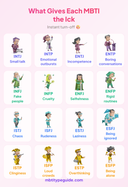
What Instantly Gives Every MBTI Type the Ick
Ever wondered what makes each MBTI type cringe? From fake enthusiasm to illogical arguments, we've got the ultimate list of instant turn-offs!
Discover Your Type
Take our free personality test and find your compatibility with all 16 types.