ESFJ and ESFJ Compatibility
Explore the relationship dynamics between ESFJ (The Consul) and ESFJ (The Consul)
ESFJ and ESFJ share 4 dimension(s) and differ on 0. This creates a dynamic relationship with both natural understanding and growth opportunities.
Shared dimensions: E/I, S/N, T/F, J/P
Compatibility by Area
What You Share
- +Both draw energy from social interaction
- +Both value practical, concrete information
- +Both prioritize values and emotional harmony
- +Both prefer structure and planned approaches
Communication Tips
Practice active listening and validate each other's perspective before offering solutions
Key Insights
- 1Warmth multiplied: the warmest pairing in the system. Both understand each other's emotional needs without explanation
- 2Approval dependency: develop some self-validation. Ask 'Am I satisfied?' before seeking the partner's confirmation
- 3Outward focus problem: develop individual inner lives. Personal hobbies and private reflection strengthen the relationship
- 4Gossip trap: redirect from processing others to processing the relationship. 'What's going on with us?' is harder but more nourishing
- 5Embracing love: it radiates outward to include everyone. Inside, both people say 'you matter' to someone who makes everyone else matter
In-Depth Analysis
1The Warmth Multiplied
Two ESFJs together create the warmest relationship in the entire type system. Both lead with Fe — extraverted Feeling. Both are attuned to others' emotions. Both create harmony instinctively. Both show love through care, attention, and the kind of nurturing that makes everyone around them feel like they belong.
The warmth multiplied is remarkable. Friends describe visiting their home as being wrapped in a blanket. Every guest is welcomed, every need anticipated, every person made to feel important. The couple's social events are legendary — not for their grandeur, but for their warmth.
Both people understand each other's emotional needs without explanation. Both know why it matters to remember the friend's anniversary. Both know why the seating arrangement at dinner matters. Both know why the tone of a text message can change the entire tenor of a day.
This understanding creates a profound emotional safety. Neither person has to justify their emotional sensitivity. Neither has to defend their need to maintain relationships. Neither has to explain why they spent an hour on the phone with a friend who needed to talk.
Both just know. And being known at that level, by someone who operates the same way, is the deepest comfort two Fe-dominants can experience.
2The Approval Dependency
Both ESFJs derive significant self-worth from others' approval. Both need to know they're valued. Both monitor the emotional temperature of their relationships for signs of disconnection.
In a healthy version, both people provide the approval the other needs. The ESFJ who says 'you're doing an amazing job' to their ESFJ partner is speaking directly to their deepest need. The recognition is mutual, consistent, and genuine.
In the shadow version, both people become dependent on each other for emotional validation — and the dependency creates fragility. When one partner is having a bad day and is less affirming than usual, the other interprets the reduced warmth as rejection. The 'rejected' partner becomes anxious, which makes them less warm, which triggers anxiety in the first partner. The spiral is fast and disorienting.
The prevention: internal sourcing. Both people must develop some capacity for self-validation — the ability to know they're doing well without being told. This doesn't come naturally to Fe-dominants, who process self-worth through others' responses. But it's essential for relationship health.
The practice: before seeking validation from the partner, ask yourself first: 'Am I satisfied with what I did?' If yes, the partner's validation becomes a bonus rather than a necessity. The relationship breathes more easily when neither person's self-worth depends entirely on the other's response.
3The Outward Focus Problem
Both ESFJs naturally focus outward — on other people's needs, other people's feelings, other people's problems. Both are so attuned to the external emotional environment that they can neglect their own inner life.
Two people who both focus outward create a relationship where both people are well-cared-for externally but potentially neglected internally. Both partners take care of each other's practical and social needs while neither addresses their own deeper emotional needs.
The problem: neither person asks 'what do I need?' Both are too busy asking 'what do you need?' This sounds generous — and it is. But it's also avoidant. Focusing on others' needs can be a way of avoiding one's own.
The question that rarely gets asked: 'What am I feeling — not about you, not about the family, not about the community — but about myself? What do I want? What am I afraid of? What brings me joy that has nothing to do with anyone else?'
Both people need to develop an inner life that exists independently of their caretaking role. Personal hobbies. Individual reflection. Private thoughts that aren't processed through the lens of 'how does this affect others?'
The couple that both develops some internal focus becomes more resilient — because each person has a self to bring to the relationship, rather than two people who each define themselves entirely through the other.
4The Gossip Trap
Fe-dominant types process the social world verbally. They talk about people — their feelings, their situations, their dynamics. This processing is natural, necessary, and usually well-intentioned.
But two Fe-dominants together can turn social processing into a feedback loop of gossip that neither person intended. The conversation starts as genuine concern: 'Did you notice that Lisa seemed upset at dinner?' It evolves into analysis: 'I think it's because Mark said that thing about her job.' It becomes judgment: 'Mark is so insensitive. He never considers how his words affect people.'
Neither ESFJ set out to gossip. Both were processing the social environment in their native mode. But the combined Fe processing can escalate social analysis into social judgment — and the relationship can develop a habit of bonding through shared criticism of others.
The awareness: when the conversation about other people becomes the primary bonding activity, something has shifted. The couple is connecting through external analysis rather than internal sharing.
The redirect: 'What's going on with us?' This question shifts the focus from processing others to processing the relationship. It's harder. It's more vulnerable. It's also more nourishing.
5The Love That Embraces
ESFJ-ESFJ love is embracing love. It wraps around both people and extends outward to include everyone in their orbit. The love doesn't stay between them — it radiates, creating a community of care that both partners build and maintain together.
The couple becomes the center of their social universe — not through charisma or power, but through care. They're the couple who hosts Thanksgiving. The couple who organizes the neighborhood watch. The couple who checks on elderly neighbors and remembers everyone's children's names.
Inside the relationship, the love is attentive and verbal. Both people say what they feel. Both people express appreciation regularly. Both people create an emotional environment where vulnerability is welcomed and tenderness is the default.
An ESFJ on their ESFJ: 'She understands me because she is me. Not literally — we're different people. But she runs on the same fuel. She needs the same things. She gives the same way. When I come home exhausted from taking care of everyone all day, she doesn't say 'what's wrong?' She says 'sit down. I made your favorite dinner.' Because she knows. She knows exactly what depletion feels like and exactly what refills the tank. She fills mine. I fill hers. And together, we never run empty.'
The other ESFJ: 'He celebrates me. Not my achievements — me. The way I arranged the flowers on the table. The way I handled the difficult conversation with his mother. The way I remembered his colleague's wife's birthday. He sees the things I do that nobody else notices, and he says: that matters. You matter. For someone who spends their life making sure everyone else matters, hearing that I matter is the most beautiful thing in the world.'
Type Profiles
The Consul
“The Provider”
ESFJs are extraordinarily caring, social, and popular people, always eager to help. They are warm-hearted, conscientious, and cooperative, with a strong desire to please and provide for others. ESFJs are the glue that holds families and communities together.
View full profileThe Consul
“The Provider”
ESFJs are extraordinarily caring, social, and popular people, always eager to help. They are warm-hearted, conscientious, and cooperative, with a strong desire to please and provide for others. ESFJs are the glue that holds families and communities together.
View full profileExplore More Pairs
Related Articles
Your Unseen Weakness: How the Inferior Function Shapes Your Closest Bonds
Often dismissed as mere 'weakness,' your least preferred cognitive function silently orchestrates profound challenges in your intimate relationships. This is not about avoiding conflict. It is about uncovering the hidden architecture of your emotional world.
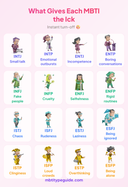
What Instantly Gives Every MBTI Type the Ick
Ever wondered what makes each MBTI type cringe? From fake enthusiasm to illogical arguments, we've got the ultimate list of instant turn-offs!
When INTJs Plan for Love: The Architect's Blueprint for Intimacy
INTJs, known for their logic, approach romance with a strategic mind. This piece unravels how these 'Masterminds' approach dating, commitment, and intimacy, finding profound connection through an unconventional path.
The Silent Conflict: How MBTI Shapes Financial Futures
Beyond superficial 'love languages,' our innate MBTI preferences significantly shape how we earn, save, and spend. Understanding these often-unseen financial 'scripts' is an important, yet frequently overlooked, element to creating deeper harmony in relationships.
Discover Your Type
Take our free personality test and find your compatibility with all 16 types.